The ultimate goal of safety policy is to reduce or even virtually eliminate risk, and policymakers and regulated industries continually face difficult decisions in working toward this objective.
Last month Rob Benedict, senior director, petrochemicals, transportation and infrastructure at AFPM, spoke with Railway Age Editor-in-Chief William C. Vantuono regarding a host of current issues facing AFPM members and freight rail shippers across the United States.
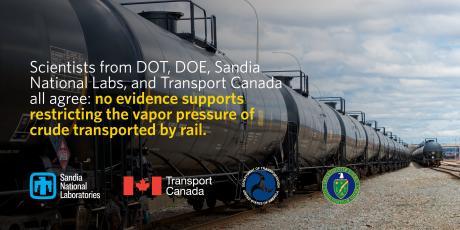
An exhaustive study by top scientists at three government agencies in two countries (DOT, DOE, and Transport Canada) has found no evidence for restricting the vapor pressure of crude oil transported by rail.
WASHINGTON, D.C. – Today, the U.S. Department of Energy, Office of Fossil Energy and the U.S. Department of Transportation, Pipeline and Hazardous Materials Safety Administration formally submitted the Congressionally-mandated Sandia National Laboratories technical report on crude oil combustion properties to Congress.
As more states limit the size of gatherings and even consider shelter-in-place policies in response to COVID-19, AFPM is working to see that refineries and petrochemical facilities.
WASHINGTON, D.C. – Richard Moskowitz, General Counsel of American Fuel & Petrochemical Manufacturers, made the following statement on North Dakota and Montana’s petition for a preemption determination regarding Washington state’s new law on allowable vapor pressure limits for crude-by-rail transport.
U.S. refiners and petrochemical manufacturers were encouraged on April 10 when President Trump signed an executive order that will better clarify the roles of federal and state agencies in permitting decisions for energy infrastructure, including oil and natural gas pipelines.
WASHINGTON, D.C. – The American Fuel & Petrochemical Manufacturers (AFPM) supports President Trump’s Executive Orders that will create clear pathways for the permitting process and support energy infrastructure development.