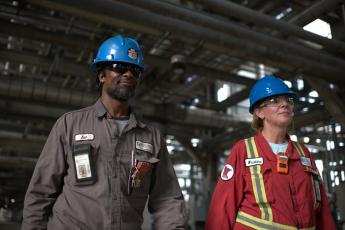
Election cycles can bring changes on the local, state, or federal level, but our responsibility to the communities where AFPM members operate remains. Being a good neighbor isn’t just a slogan — it’s a commitment. So, what does that look like in practice? We asked leaders from Flint Hills Resources and Phillips 66 to share how they turn that commitment into action.
What does being a good neighbor mean?
To the leaders at Phillips 66 and Flint Hills Resources, being a good neighbor is more than a corporate responsibility — it’s a personal philosophy. Melissa Erker, director of public affairs for the west region at Phillips 66 likens it to living in a residential neighborhood: “You don’t just go over to your neighbor’s house on the first day and expect trust. You build it over time.” Geoff Glasrud, vice president and manufacturing manager at Flint Hills Resources, echoes this sentiment, emphasizing the importance of treating others — and the environment — with the same respect and care one would expect for themselves if they lived across the street from a refinery. “It’s about integrity, transparency and mutual benefit,” he says.
Safety beyond compliance
Both companies stress that safety and environmental stewardship are foundational, not optional. “Compliance is the floor, not the ceiling,” says Jake Reint, vice president for public affairs at Flint Hills Resources. “Safety is always the number one priority. We live with hazards all around us, and our goal is to keep people safe — every single day.” Their approach is principle-based, driven by stewardship and continuous improvement. Heath Wanamaker, vice president of Phillips 66 emphasizes a commitment that goes beyond simply following the rules. “Our responsibility isn’t just to meet regulatory requirements — it’s to do what’s right for our employees and the communities where we operate, every single day. Safety and environmental stewardship are our guiding principles.”
At the Wood River Refinery, internal audits, corporate reviews and proactive technology adoption — like AI-powered confined space monitoring and flare cameras — ensure operations exceed regulatory standards. Flint Hills takes a similar approach, with 650 low-level air quality sensors deployed across the plant and fenceline — none of which are required by law. These tools provide transparency and early detection, reinforcing their commitment to community reassurance.
Both teams emphasize that safety is a core value — maintained consistently over time and independent of political shifts. “Our values and expectations remain the same,” says Erker. “We’re committed to safe, reliable, environmentally conscious operations.” Glasrud adds, “Our culture is our culture. It’s principle-based and doesn’t waver.”
Transparency and trust
Open communication is central to building trust. Phillips 66 maintains a robust Community Advisory Panel (CAP) with monthly meetings, composed of fenceline neighbors, educators, emergency responders and small business owners. “They set the agenda,” Erker explains. “We want two-way dialogue.” The refinery also operates a 24/7 community concern line with a live responder and proactively communicates via email and phone calls with schools and local officials before any potentially abnormal or disruptive activity occurs.
Flint Hills Resources has revitalized its long-standing Community Advisory Council, ensuring it remains a vibrant forum for engagement. “We meet monthly, after hours, and answer every question,” says Reint. “It’s all fair game.” Their transparency extends to social media updates during incidents and regular public tours, including milestone open houses that draw thousands.
Investing in community wellbeing
Both companies demonstrate a deep and enduring commitment to the communities where they operate. At Phillips 66, this commitment is structured around education, equity, safety and environmental stewardship. “Social impact is an important part of what we do in every community where we operate,” says Erker. “We focus on education, equity, safety and the environment — and we back that up with both financial support and volunteer time.” Through its “Good Energy” volunteer program, employees contribute hands-on support to local projects, from planting trees to renovating community spaces. In 2024 alone, Wood River employees generated more than $250,000 in community investments through volunteerism.
Flint Hills Resources applies the same disciplined approach to community partnerships that it does to business decisions. “We apply the same rigor to community partnerships that we do to business decisions — making sure resources deliver real impact,” explains Reint. This philosophy drives initiatives like Project Green Fleet, a collaboration to install pollution-control equipment in thousands of diesel vehicles and Project CAR, a project that helps reduce emissions and improve access to reliable transportation, both of which deliver measurable environmental benefits. Beyond environmental programs, Flint Hills invests in local fire and law enforcement training facilities, STEM education, and long-standing partnerships with organizations such as Ducks Unlimited and the Minnesota Zoo. “Our partnerships aren’t just about writing checks,” Reint adds. “We invest time and talent to advance shared goals like clean air, STEM education and safety.”
Both companies also step up in times of crisis. Phillips 66 responded to severe flooding in their community by deploying pumps, providing funding and partnering with the Red Cross to assist affected families. Flint Hills Resources demonstrated similar care during a propane release that required evacuations. “We made sure families were cared for with dignity and respect — finding hotels, meeting personal needs and minimizing disruption,” says Reint. “We treat people the way we’d want our own families treated.”
Our ongoing commitment
“We’ve been here for over 100 years, and our commitment hasn’t changed,” says Erker. Glasrud adds, “Our culture is relentless in improving operations. We don’t change who we are.”
Both companies reaffirm that their accountability lies with their employees and communities regardless of election outcomes. Their message to neighbors is one of consistency, transparency, and unwavering commitment.
The American Fuel & Petrochemical Manufacturers (AFPM) is the leading trade association representing the makers of the fuels that keep us moving, the petrochemicals that are the essential building blocks for modern life, and the midstream companies that get our feedstocks and products where they need to go. We make the products that make life better, safer and more sustainable — we make progress.